

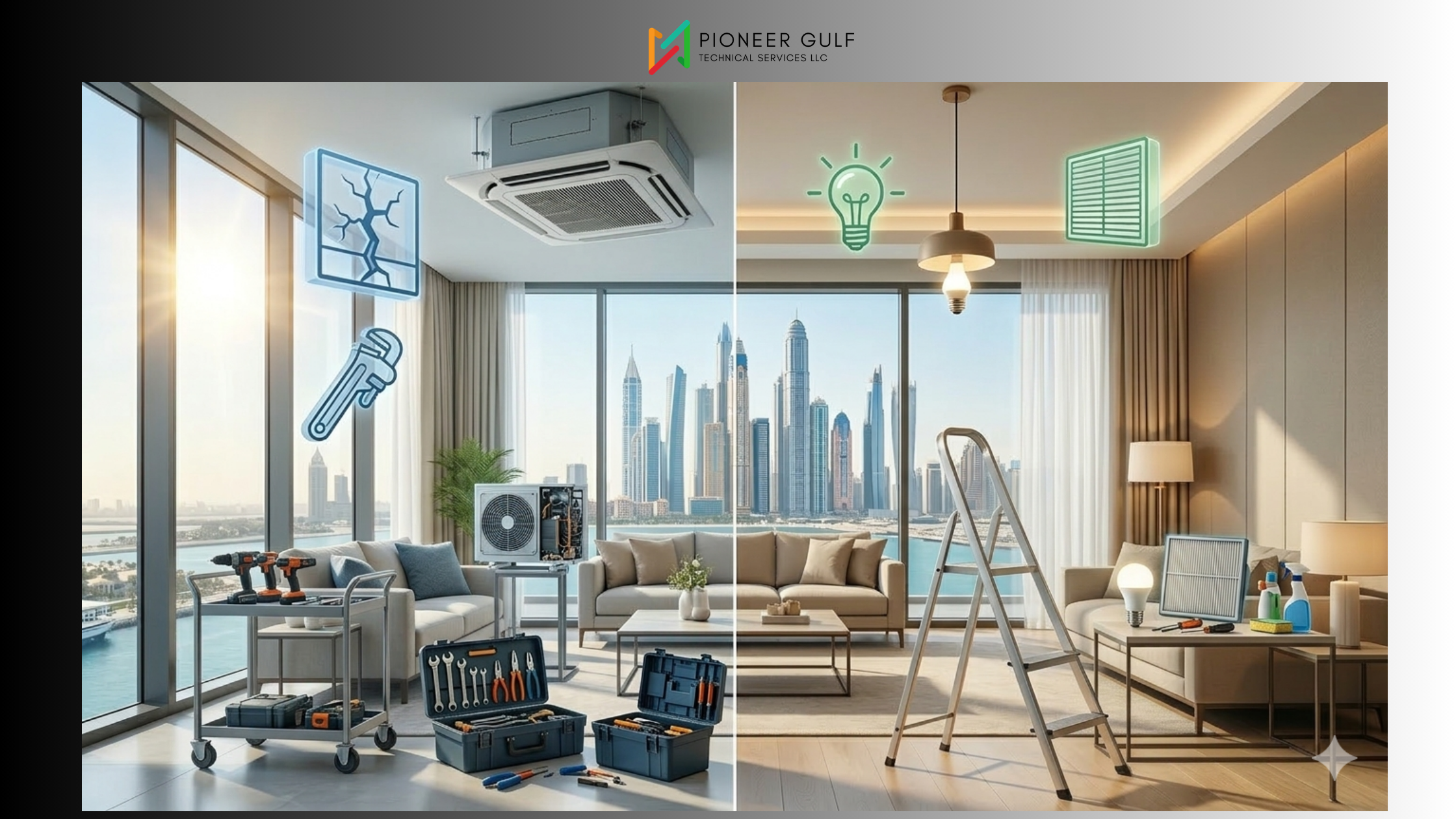
Quick Answer: Landlord vs. Tenant Maintenance in Dubai
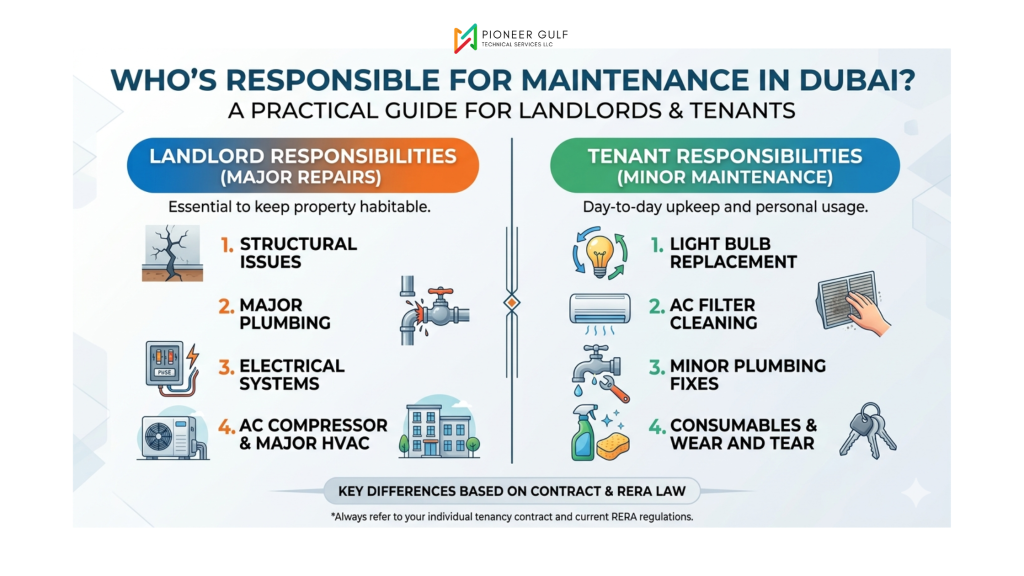
General Rule: Repairs costing over AED 500-1,000 (threshold varies by contract) are landlord responsibility. Repairs under this amount are tenant responsibility.
- Landlord Pays: Major repairs like AC compressor replacement, water heater replacement, structural issues, electrical panel problems
- Tenant Pays: Minor repairs like light bulbs, AC filters, small plumbing fixes, fuses
- Gray Areas: Items near the threshold or wear-and-tear issues often require discussion between parties
Note: Always check your specific rental contract for the exact threshold and responsibilities.
Important Note
The prices and timelines mentioned are for conceptual and informational purposes only. We do not make any official claims regarding their accuracy. For precise cost estimates and project timelines, we recommend consulting qualified professionals or relevant experts.
Lets Start!
Three months into the Dubai tenancy, the AC in your bedroom stops cooling. Outdoor temperature is 42°C. Someone need it fixed immediately.
But who pays for the repair—you or your landlord?
Tenant call the landlord. They say “minor repairs are tenant responsibility, check your contract.” You check the contract. It says “tenant responsible for maintenance costs under AED 1,000.” The AC repair quote comes back at AED 1,200.
Now what?
This situation may plays out daily across Dubai apartments and villas. The confusion isn’t because tenants or landlords are unreasonable—it’s because maintenance responsibility in Dubai rental properties follows principles that aren’t always intuitive, especially for people new to the UAE.
This guide explains how maintenance costs are typically divided in Dubai, what the usual thresholds are, and how to handle common situations that create disputes.
The Basic Principle: Major vs. Minor Maintenance
Dubai rental relationships operate on a practical division: major maintenance is typically the landlord’s responsibility, while minor maintenance falls to the tenant.
This makes sense when you think about it. Landlords own the property and benefit from its long-term value. Major issues—structural problems, system failures, significant repairs—affect property value and lifespan. Landlords logically bear these costs.
Tenants occupy the property temporarily and use its facilities daily. Minor wear and tear, small fixes, routine replacements—these result from normal occupancy. Tenants logically handle these costs.
The challenge comes in defining “major” versus “minor.” This is where the cost threshold becomes important.
The Cost Threshold: Where Major and Minor Divide
Most Dubai rental contracts specify a monetary threshold separating major from minor maintenance. Common thresholds include:
AED 500 – Lower threshold, tenant pays repairs under this amount AED 1,000 – Most common threshold in Dubai residential contracts AED 1,500 – Higher threshold, more tenant-friendly
How this works in practice:
Example 1: AC Filter Replacement Cost: AED 120 Threshold: AED 1,000 Responsibility: Tenant (under threshold)
Example 2: AC Compressor Failure Cost: AED 3,500 Threshold: AED 1,000
Responsibility: Landlord (exceeds threshold)
Example 3: Plumbing Leak Repair Cost: AED 850 Threshold: AED 1,000 Responsibility: Tenant (under threshold)
The threshold creates a clear decision point. Repair costs below it fall to tenant. Costs exceeding it fall to landlord.
What if Your Contract Doesn’t Specify a Threshold?
Some contracts don’t mention a specific amount. In these cases, Dubai rental practice generally follows the principle that landlords handle substantial repairs while tenants handle minor ones. If a dispute arises, the question becomes: “Is this repair substantial enough that maintaining property value requires the owner to pay for it?”
Compressor replacements, water heater replacements, major plumbing leaks, electrical panel issues—these are substantial. Light bulbs, filters, minor tap repairs, door handles—these are minor.
When contracts are silent and parties disagree, resolution often requires negotiation or, in extreme cases, formal dispute resolution through rental dispute processes.
Common Maintenance Scenarios: Who Pays?
Let’s examine specific situations Dubai tenants and landlords encounter:
Air Conditioning
Filter Cleaning/Replacement (AED 80-150): Tenant Regular filter maintenance results from daily use. Most contracts make this tenant responsibility regardless of cost threshold.
AC Service/Coil Cleaning (AED 250-600): Depends on threshold Quarterly AC service costs typically fall under AED 1,000 threshold, making this tenant responsibility in most contracts. However, some landlords include annual AC service in their obligations or negotiate sharing costs.
Refrigerant Top-Up (AED 300-600): Gray area If refrigerant is low due to a leak (system defect), landlord typically pays. If low due to normal depletion over years of use, might be tenant responsibility. This often requires discussion.
Compressor Replacement (AED 1,500-4,000): Landlord This exceeds typical thresholds and represents major system failure, not tenant-caused damage. Landlord responsibility in nearly all cases.
Complete Unit Replacement (AED 2,500-6,000): Landlord Major capital expense maintaining property value. Clear landlord responsibility.
Plumbing
Tap Washer Replacement (AED 50-150): Tenant Minor maintenance from normal use.
Blocked Sink/Toilet (AED 150-400): Tenant If blockage results from tenant usage (hair, objects dropped, improper items flushed), tenant pays. If blockage results from pipe defects or building-wide issues, landlord may be responsible.
Leaking Tap Repair (AED 200-500): Depends on threshold Falls under typical AED 1,000 threshold, making it tenant responsibility in most contracts. However, if leak causes property damage, landlord may become involved.
Burst Pipe (AED 600-2,000+): Landlord Major repair, typically exceeds threshold, affects property structure. Landlord responsibility unless tenant demonstrably caused the damage.
Water Heater Replacement (AED 800-2,500): Usually landlord Often exceeds threshold and represents equipment failure, not tenant wear and tear. Most landlords accept this responsibility.
Electrical
Light Bulb Replacement (AED 10-50): Tenant Clear tenant responsibility from normal use.
Fuse Replacement (AED 20-100): Tenant Minor electrical maintenance.
Switch/Socket Replacement (AED 100-300): Tenant If under threshold and resulting from normal use. However, if electrical issues create safety hazards, landlords often handle repairs regardless of cost to avoid liability.
Electrical Panel Issues (AED 800-2,500): Landlord Major electrical work affecting building systems. Safety considerations also push this toward landlord responsibility.
Complete Rewiring (AED 5,000-20,000): Landlord Major capital improvement maintaining property safety and value.
Painting
Touch-Up Small Areas (AED 200-500): Tenant Minor wear from occupancy.
Repaint One Room (AED 500-1,500): Depends on threshold and cause If repainting is needed due to normal wear over years of occupancy, this often becomes negotiation territory. Some contracts require landlords to repaint every few years. Others make tenants responsible unless excessive damage exists.
Repaint Entire Property (AED 3,000-10,000): Usually landlord Especially if property was last painted years ago or tenant occupied for many years. However, if tenant caused damage requiring repainting before normal wear cycle, tenant might be responsible.
Appliances
Dishwasher/Washing Machine Repair (AED 300-800): Gray area If landlord provided appliance as part of furnished property, repairs typically fall to landlord. If tenant brought own appliance, tenant obviously responsible. This is why inventory lists documenting what landlord provides matter.
Refrigerator Compressor Failure (AED 1,200-3,000): Landlord If landlord-provided appliance, this is landlord responsibility as major appliance failure.
Oven Element Replacement (AED 200-600): Depends on threshold Under AED 1,000 threshold might be tenant, but many landlords handle this as it’s landlord-provided equipment failure.
What Your Rental Contract Should Specify
To avoid disputes, Dubai rental contracts should clearly state:
1. The Maintenance Threshold “Tenant is responsible for maintenance and repairs costing less than AED 1,000. Landlord is responsible for maintenance and repairs costing AED 1,000 or more.”
2. Routine Maintenance Expectations “Tenant is responsible for routine maintenance including but not limited to: AC filter cleaning/replacement, light bulb replacement, minor plumbing repairs under AED 1,000, and minor electrical repairs under AED 1,000.”
3. Major System Responsibilities “Landlord is responsible for major system repairs and replacements including but not limited to: AC compressor failures, water heater replacement, structural issues, major plumbing repairs, and electrical panel issues.”
4. Appliance Responsibilities “Landlord is responsible for repair and replacement of all appliances provided with the property as listed in the inventory.”
5. Repainting Schedule “Landlord will repaint the property every [X years] OR Tenant is responsible for repainting at end of tenancy if required beyond normal wear.”
6. Response Time Expectations “Landlord will arrange repairs for landlord-responsibility items within [X] days of notification. Emergency repairs will be addressed within [X] hours.”
The clearer the contract, the fewer disputes arise.
The Gray Areas: Situations Requiring Discussion
Some maintenance situations don’t fit neatly into major/minor categories:
Wear and Tear vs. Damage
Scenario: Carpet shows heavy wear after three years of occupancy.
Is this normal wear (landlord responsibility to replace as property maintenance) or tenant damage (tenant responsibility to compensate)?
The answer often depends on lease duration, carpet quality and age when tenant moved in, and extent of wear. A tenant occupying property for five years shouldn’t be held responsible for carpet that was already old when they moved in and is now worn from normal use. Conversely, a tenant who occupied for one year and somehow destroyed new carpet probably bears responsibility.
These situations require reasonable discussion between parties.
Preventive Maintenance
Scenario: AC hasn’t been serviced in 18 months. It fails. Repair costs AED 2,000.
Who pays? Landlord pays for the repair (exceeds threshold). But was tenant supposed to maintain the AC through regular servicing, which might have prevented this failure?
This highlights why clear contracts specifying who handles routine preventive maintenance (quarterly AC service, annual water tank cleaning, etc.) prevent disputes. If contract makes tenant responsible for AC service and tenant neglected it, landlord might argue tenant caused the failure. If contract is silent or makes landlord responsible for AC service, tenant isn’t at fault.
Emergency Repairs
Scenario: Major water leak occurs at midnight. Tenant calls emergency plumber who charges AED 1,500 to stop the leak.
Landlord is responsible for this cost (major leak, exceeds threshold). But should tenant have waited to contact landlord before calling emergency service? What if landlord was unreachable? What if waiting would have caused extensive property damage?
Reasonable landlords understand that genuine emergencies requiring immediate action may result in tenants arranging repairs that are ultimately landlord responsibility. Good tenants document emergencies, get landlord approval when possible, provide receipts, and don’t take advantage.
Clear contracts can address this: “In emergency situations where landlord cannot be reached and immediate repair is necessary to prevent property damage, tenant may arrange emergency repairs up to AED [X] with landlord reimbursing costs upon receipt of documentation.”
Practical Tips for Tenants
1. Document Everything Take photos/videos of property condition when you move in. This proves what condition things were in at the start, protecting you from being blamed for pre-existing issues.
2. Report Issues Promptly Don’t let small problems become big ones. If you notice a small leak and don’t report it, it might become major water damage that you’re liable for because you didn’t notify the landlord when it was minor.
3. Get Written Approval for Repairs If you arrange repairs—even minor ones you’re paying for—inform your landlord in writing. For repairs exceeding threshold that landlord should pay, get written approval before proceeding. WhatsApp messages, emails—anything documenting agreement helps.
4. Keep Receipts Save all receipts for any repairs you pay for. You might need to prove these were necessary tenant-responsibility items versus landlord-responsibility items you shouldn’t have been charged for.
5. Understand Your Contract Read the maintenance clause carefully. Know your threshold. Understand what routine maintenance you’re expected to handle. Don’t rely on verbal agreements—get contract amendments in writing.
6. Propose Reasonable Solutions If a repair falls in a gray area, propose splitting costs or another reasonable solution rather than demanding landlord pay everything. Landlords appreciate reasonable tenants and may be more flexible.
Practical Tips for Landlords
1. Use Clear Contracts Invest in a well-drafted rental contract with clear maintenance responsibilities. The AED 500-1,000 you spend on proper contract preparation saves thousands in dispute costs.
2. Maintain Your Property Don’t defer major maintenance hoping tenants will pay. Replace aging equipment before it fails. Service AC systems regularly. Good landlords who maintain properties well have fewer disputes and better tenant retention.
3. Respond Quickly When tenants report issues that are your responsibility, arrange repairs promptly. Tenants who feel abandoned by unresponsive landlords either arrange repairs themselves (creating disputes about reimbursement) or withhold rent (creating bigger problems).
4. Be Reasonable About Wear Don’t try to charge tenants for normal wear and tear. Carpets wear out. Paint fades. Equipment ages. If a tenant occupied your property for three years and generally took good care of it, don’t nickel-and-dime them over minor wear.
5. Consider Including Service Some landlords include annual AC service or other preventive maintenance as part of their responsibility. This might cost you AED 500-1,000 annually but prevents disputes, ensures property is maintained properly, and keeps tenants happy.
6. Build Relationships Good tenant-landlord relationships prevent most disputes. Treat tenants respectfully, maintain the property well, respond to legitimate issues promptly, and most tenants will treat your property well and be reasonable about minor issues.
When Disputes Arise?
Despite best intentions, maintenance disputes sometimes occur. If you and your landlord (or tenant) cannot agree:
Step 1: Document and Communicate Put everything in writing. Email or WhatsApp the landlord explaining the issue, relevant contract clause, and why you believe responsibility falls where you claim. Give them reasonable time to respond.
Step 2: Propose Mediation Suggest meeting to discuss the issue or bringing in a neutral third party. Sometimes disputes arise from misunderstanding rather than bad faith.
Step 3: Formal Process Dubai has established rental dispute resolution processes. While specifics of these processes aren’t covered in detail here, resources exist for tenants and landlords to resolve disputes formally if needed.
Most disputes don’t reach formal processes if both parties act reasonably and contracts are clear.
The Role of Property Management Companies
Many Dubai landlords use property management companies to handle tenant relationships and maintenance. If your landlord uses a management company:
- Report all maintenance issues to the property management company as your contract specifies
- Management companies should have clear processes for maintenance requests
- Response times may be specified in your management agreement
- Major repairs still require landlord approval even if arranged through management company
Management companies can help streamline maintenance because they have established contractor relationships and clear processes. However, they don’t change fundamental landlord/tenant responsibility divisions.
Preventive Maintenance: Everyone Benefits
The least expensive maintenance is maintenance that prevents problems:
For Tenants:
- Replace AC filters regularly (every 1-2 months during summer)
- Report small issues before they become big problems
- Don’t ignore strange noises, small leaks, or minor malfunctions
- Use property systems properly (don’t overload electrical circuits, don’t flush inappropriate items, etc.)
For Landlords:
- Schedule annual or quarterly AC service
- Replace aging equipment before catastrophic failure
- Address tenant-reported issues promptly
- Conduct periodic property inspections (with proper notice)
Properties maintained preventively have fewer emergency repairs, lower long-term costs, and happier tenant-landlord relationships.
Common Sense Prevails
Most Dubai tenants and landlords are reasonable people who want fair outcomes. Contracts establish frameworks, but relationships matter too.
Good tenants who maintain properties well, report issues promptly, and act reasonably usually find landlords willing to be flexible on borderline maintenance costs.
Good landlords who maintain properties properly, respond to issues quickly, and treat tenants respectfully usually find tenants willing to handle minor items without complaint.
The threshold system—landlord paying for major repairs, tenant paying for minor ones—works well when both parties act in good faith.
When you move into a Dubai rental property, you’re entering a relationship that will ideally last years. Investing time upfront to understand maintenance responsibilities, document property condition, and establish good communication patterns prevents most problems from ever arising.
And when issues do arise—because even in the best-maintained properties, things occasionally break—clear contracts, reasonable discussion, and documented communication resolve them efficiently.
Need Help with Property Maintenance in Dubai?
Pioneer-Gulf provides professional maintenance services for both landlords and tenants across Dubai:
For Tenants:
- Transparent pricing (you know costs before work begins)
- Help determining if repairs are tenant or landlord responsibility
- Documentation for landlord reimbursement claims
- Quality work meeting Dubai Municipality standards
For Landlords:
- Preventive maintenance programs keeping properties in excellent condition
- Fast response to tenant-reported issues
- Fair pricing maintaining your investment
- Regular property inspections identifying issues early
Services Include:
- AC maintenance and repair
- Plumbing services
- Electrical work
- Painting and maintenance
- Complete villa and apartment maintenance
Whether you’re handling tenant-responsibility minor maintenance or landlord-responsibility major repairs, professional service ensures work is done right the first time.
Frequently Asked Questions About Maintenance Responsibilities in Dubai
Who is responsible for AC repairs in Dubai rental properties?
In most Dubai rental agreements, landlords are responsible for major air conditioning repairs and system failures. Tenants may handle basic upkeep such as cleaning filters or reporting issues early. When cooling systems malfunction, professional AC maintenance services can inspect and repair the system to restore proper performance.
What maintenance responsibilities do tenants typically have in Dubai?
Tenants are generally responsible for minor maintenance tasks such as replacing light bulbs, keeping drains clear, maintaining cleanliness, and basic upkeep of fixtures. These routine responsibilities help prevent larger problems that may require professional repair services.
What repairs are landlords responsible for in Dubai properties?
Landlords usually handle major repairs affecting the property’s structure or essential systems. This may include plumbing failures, electrical issues, air conditioning system breakdowns, or structural damage. Professional plumbing services or electrical repair specialists are often required to resolve these problems safely.
Is there a maintenance cost threshold between tenant and landlord responsibilities?
Many tenancy contracts in Dubai define a maintenance cost threshold. Repairs below the agreed amount may be the tenant’s responsibility, while higher-cost repairs typically fall under the landlord’s responsibility. The specific threshold varies depending on the rental agreement.
When should professional maintenance services be used in rental properties?
Professional services should be used whenever repairs involve technical systems such as electrical wiring, plumbing networks, air conditioning units, or structural renovation work. For example, professional painting services or property refurbishment specialists may be needed when restoring or upgrading rental properties.