

Executive Summary
Most renovation disputes in Dubai don’t start with bad workmanship — they start with mismatched expectations. Homeowners who understand the process before work begins are better equipped to ask the right questions, identify problems early, and hold their contractor accountable at every stage.
This guide walks through the villa renovation phases of an project in Dubai — what happens at each stage, why the sequence matters, and what a homeowner should be looking for. Whether your project covers a single room or the entire property, the underlying process is the same. Understanding it is one of the most valuable things you can do before signing any contract.
Why Phase Sequence Matters in Villa Renovation
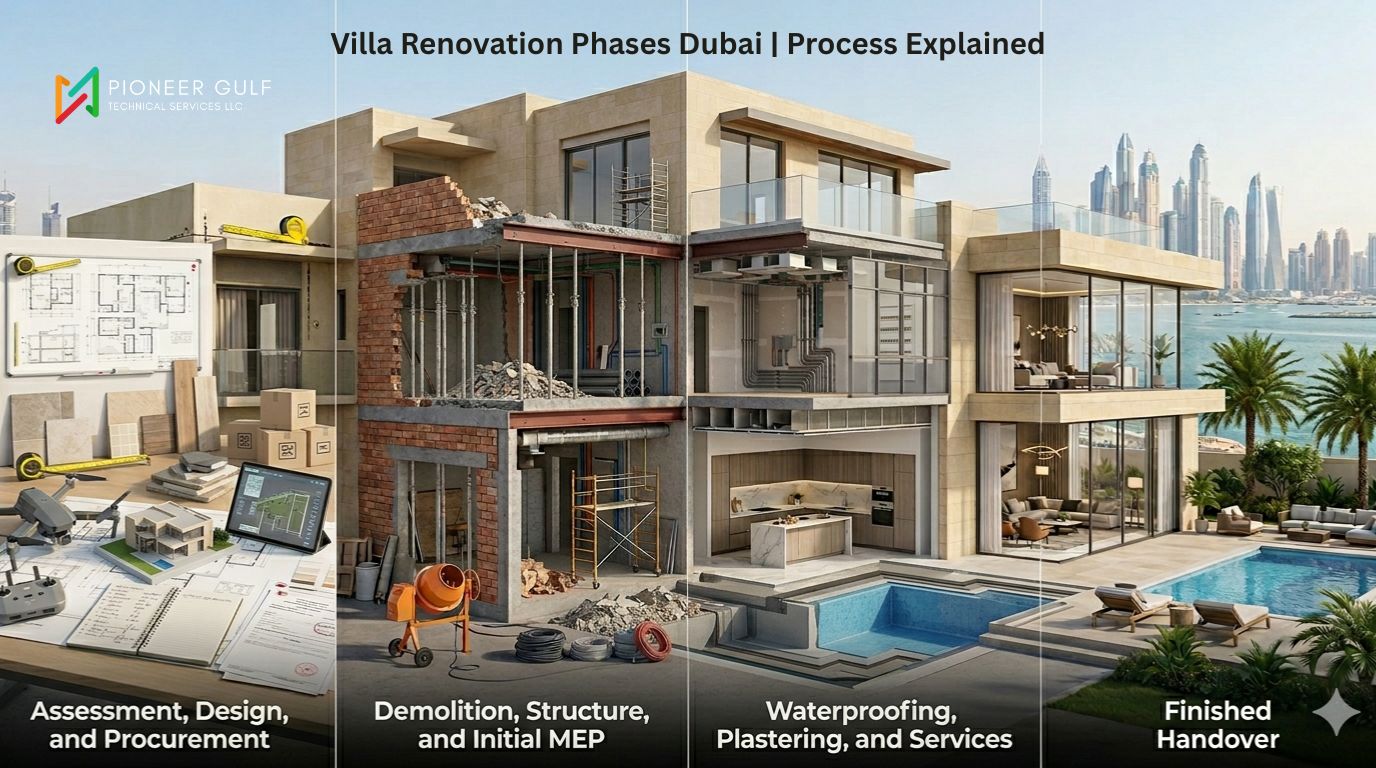
Renovation is not a collection of independent tasks — it is a sequence where each phase creates the conditions for the next. When trades arrive out of order, the results range from inconvenient to expensive. Tiling before waterproofing cures creates leaks. Closing walls before MEP runs are inspected buries compliance issues. Painting before joinery is fitted means repainting.
A contractor with genuine project management capability sequences trades deliberately and communicates clearly when one phase must complete before the next can begin. This is one of the clearest signals of professional competence — and its absence is one of the clearest warning signs.
Why Phase Sequence Matters in Villa Renovation
Renovation is not a collection of independent tasks — it is a sequence where each phase creates the conditions for the next. When trades arrive out of order, the results range from inconvenient to expensive. Tiling before waterproofing cures creates leaks. Closing walls before MEP runs are inspected buries compliance issues. Painting before joinery is fitted means repainting.
A contractor with genuine project management capability sequences trades deliberately and communicates clearly when one phase must complete before the next can begin. This is one of the clearest signals of professional competence — and its absence is one of the clearest warning signs.
The Phases of a Dubai Villa Renovation
Phase 1: Assessment and Scope Definition
Every well-run renovation begins with a thorough site assessment. Before any price is discussed, a qualified technical team should inspect the property to understand existing conditions, identify visible or probable issues, and confirm what is feasible within the structure and systems of the building.
The output of this phase is a written scope of work — a document that specifies what will be done, where, to what standard, and with what materials. This document becomes the contract. Without it, every subsequent decision is open to interpretation.
Pioneer Gulf’s position: no quotation is issued without a site visit. No work begins without a written, itemised scope of work signed by both parties.
Phase 2: Design Confirmation and Material Selection
Once scope is agreed, design decisions are confirmed — layouts, finishes, material selections, colour schemes. This phase is frequently underestimated by homeowners and frequently mismanaged by contractors who allow it to drag into the construction phase.
The critical discipline here is early decision-making. Certain materials — premium tiles, bespoke joinery, branded sanitaryware, specialist fixtures — may have significant procurement lead times. Every day a material decision is delayed at this stage is a potential delay to the construction programme later.
- What to do: Confirm all material selections before demolition begins. Request written confirmation of lead times from your contractor for all specified items.
- What to watch for: Contractors who begin demolition before materials are confirmed are creating a schedule dependency that will almost certainly cause delays.
Phase 3: Procurement
Materials must be ordered, delivered, and inspected before the phases that require them can proceed. This is an invisible phase to most homeowners — but delays here are the single most common cause of construction programme disruption in Dubai villa renovation.
A contractor who orders materials reactively — as each trade needs them — is not managing your project. A contractor who maps material lead times against the construction sequence and orders accordingly is.
Phase 4: Demolition and Strip-Out
Controlled demolition removes existing finishes, fixtures, and any structural elements within the defined scope. ‘Controlled’ is the operative word. Demolition that damages adjacent finishes, MEP systems, or structural elements outside the scope creates rework and cost.
This is also the phase where hidden conditions most commonly emerge — conditions invisible during the initial assessment because they were behind tiles, inside walls, or under screed. Corroded pipe work, degraded waterproofing, aged electrical wiring, and damp penetration are all common discoveries in Dubai villas that are more than a decade old.
A professional contractor notifies the homeowner of any hidden condition in writing, presents options with implications for scope and cost, and awaits approval before proceeding. Work should not continue past a hidden condition without the homeowner’s informed agreement.
Phase 5: Structural and MEP Rough-In
If the project involves structural changes — new openings, modified layouts, reconfigured spaces — these are executed in this phase before any finishing work begins. MEP rough-in involves laying new pipe runs, conduit, and AC duct in their final positions before walls are closed.
This phase must be completed and, where appropriate, inspected before walls are plastered and ceilings are boarded. MEP systems buried without inspection create long-term maintenance and compliance risks.
Phase 6: Waterproofing
Waterproofing of wet areas — bathrooms, wet rooms, utility areas, balconies — is applied before any tiling begins. This phase has a non-negotiable requirement: curing time.
Waterproofing systems are applied in multiple coats and require defined intervals between coats and a mandatory curing period before any load or water contact. The standard professional practice is a flood test — filling the waterproofed area with water and leaving it for a defined period to verify that no moisture penetrates the substrate.
Pioneer Gulf conducts a flood test on all waterproofed surfaces before tiling begins. This is a non-negotiable quality standard — not an optional extra.
Waterproofing failures — most commonly caused by insufficient curing time or inadequate membrane coverage — are among the most expensive defects to repair in a completed renovation, because rectification requires removing all the tiling applied above them.
Phase 7: Tiling, Plastering, and Civil Finishes
Floor and wall tiling, plastering, cornicing, and screeding are executed in this phase — the phase most visible to homeowners during site visits. Tile setting, grout selection, and joint alignment are skilled work. The quality of this phase defines the visual impression of the finished renovation.
Tile cuts at perimeters, consistency of grout lines, and the handling of transitions between different floor finishes are the details that separate competent tiling from excellent tiling.
Phase 8: Joinery and Fit-Out
Kitchen cabinetry, wardrobes, bespoke joinery, door frames, window treatments, and built-in furniture are installed in this phase. Joinery must be fitted plumb, level, and square — deviations that are invisible at installation become visible and functional problems over time.
In Dubai’s climate, joinery materials must be selected for thermal stability. Solid wood joinery that performs well in temperate climates can warp and crack under Dubai’s temperature and humidity cycling if not correctly specified or treated.
Phase 9: Second Fix MEP
With walls closed and joinery in place, MEP systems are completed: sanitaryware is installed, electrical fittings and light fixtures are fitted, switches and sockets are installed, and air conditioning units and grilles are commissioned. Second fix MEP requires coordination — each trade needs the previous one to be complete before it can work.
Phase 10: Painting and Decoration
Painting is executed after all trades that could damage finished paint are complete. In Dubai, painting is a more technical activity than it appears — surface preparation, primer selection, and the number of finish coats all affect durability against humidity and thermal cycling. Anti-mould primer is standard practice in bathrooms and other high-humidity spaces.
Phase 11: Snagging and Handover
Snagging is a systematic, documented inspection of every finished surface, fitting, and function in the renovated spaces. It identifies defects, incomplete items, and deviations from the agreed specification. All items on the snag list are resolved before the project is considered complete and before final payment is released.
This phase is frequently omitted or rushed by contractors who consider project sign-off a formality. It is not. A properly conducted snagging inspection is the homeowner’s last opportunity to hold the contractor to the agreed standard before the warranty period begins.
- What to do: Conduct snagging yourself before the joint inspection, with a checklist. Then conduct the joint inspection with the contractor present.
- What to watch for: Contractors who pressure you to sign off without a formal snagging process, or who treat snag items as minor issues to resolve ‘when we have a chance.’
The Phases of a Dubai Villa Renovation
Phase 1: Assessment and Scope Definition
Every well-run renovation begins with a thorough site assessment. Before any price is discussed, a qualified technical team should inspect the property to understand existing conditions, identify visible or probable issues, and confirm what is feasible within the structure and systems of the building.
The output of this phase is a written scope of work — a document that specifies what will be done, where, to what standard, and with what materials. This document becomes the contract. Without it, every subsequent decision is open to interpretation.
Pioneer Gulf’s position: no quotation is issued without a site visit. No work begins without a written, itemised scope of work signed by both parties.
AEO (Frequently Asked Quetions)
A villa renovation in Dubai follows a defined sequence of phases: site assessment and scope definition; design confirmation and material selection; procurement; demolition and strip-out; structural and MEP rough-in (where applicable); waterproofing; tiling, plastering, and civil finishes; joinery and fit-out; second fix MEP; painting and decoration; and snagging and formal handover. The sequence matters — each phase creates the conditions for the next. A contractor who cannot explain this sequence clearly does not have a genuine project management process.
Hidden conditions — corroded pipework, aged wiring, failed waterproofing, damp penetration — are not uncommon in older Dubai villas, because they are invisible behind tiles, walls, and screeds until demolition begins. A professional contractor documents the discovery, presents the homeowner with options and their implications, and obtains written approval before proceeding. Work should never continue past a hidden condition discovery without the homeowner’s informed agreement. Be cautious of contractors who proceed without consultation and present the cost as a done fact.
Dubai’s thermal cycling, humidity levels, and the intensity of water use in bathrooms and wet areas make waterproofing one of the most technically critical phases in any renovation. Waterproofing failures — caused by insufficient curing time, inadequate coverage, or poor material selection — cannot be fixed without removing all the tiling applied above the membrane. The cost of rectification is significantly higher than the cost of doing it correctly the first time. Pioneer Gulf conducts a flood test on all waterproofed surfaces before tiling begins.
Snagging is a systematic, documented inspection of all finished surfaces, fittings, and functions in the renovated property, conducted before final payment is released. It identifies defects, incomplete items, and deviations from the agreed specification. A proper snagging process protects the homeowner by ensuring all identified issues are resolved before the contractor’s financial obligation is fully discharged. Contractors who discourage or rush the snagging process are contractors who expect some defects to remain the homeowner’s long-term problem.
Pioneer Gulf assigns a dedicated project manager to every villa renovation project — a single point of accountability for trade sequencing, quality control, procurement coordination, client communication, and progress reporting. All core trades are directly employed by Pioneer Gulf, not subcontracted to third parties. Every project proceeds under a written contract with an itemised scope of work, and concludes with a formal snagging inspection before final sign-off.